Introduction: The Unseen Battle for Your Health 🏥
Imagine a future where a microscopic anomaly, invisible to the human eye, is instantly flagged by an intelligent machine, guiding your doctor to a life-saving diagnosis. This isn’t science fiction anymore. We stand at the precipice of a medical revolution, where Generative AI in medical diagnosis is no longer just assisting but actively reshaping how diseases are detected and treated. The burning question on everyone’s mind: Is it AI vs Human Radiologists, or are we witnessing a powerful new era of collaboration?
We stand at the precipice of a medical revolution, where Generative AI in medical diagnosis is no longer just assisting but actively reshaping how diseases are detected and treated. The burning question… The sheer volume of data makes effective and timely reads increasingly challenging. This massive bottleneck is precisely why the field of Generative AI in medical diagnosis has garnered such immense attention from researchers, clinicians, and tech developers globally. The advancements promise not just efficiency, but a new standard of care.
For decades, human radiologists have been the unsung heroes of medicine, meticulously analyzing X-rays, CT scans, MRIs, and countless other images to uncover the secrets hidden within our bodies. Their expertise is invaluable, but they face an ever-increasing deluge of data and an inherent human limitation – fatigue, oversight, and the sheer volume of cases.
Enter Generative AI. Far beyond simple pattern recognition, these sophisticated algorithms are learning, reasoning, and even creating new insights from medical data at an unprecedented scale. This isn’t just about faster reads; it’s about seeing what was previously unseeable, predicting what was unpredictable, and ultimately, delivering precision treatment that is tailored to you.
The ultimate goal is not to replace human intuition and compassion with cold algorithms, but to empower our medical heroes with tools that enable them to save more lives, more efficiently, and with greater precision than ever before. The future of medical diagnosis is a powerful partnership, and the successful integration of Generative AI in medical diagnosis is the key.
In this exhaustive guide, we’ll dive deep into:
- The Radiologist’s Burden: Why AI’s intervention is not just welcome, but necessary.
- What is Generative AI? Understanding the technology that’s transforming diagnosis.
- Key Applications: Where Generative AI is already making a difference.
- Real-World Examples: Inspiring case studies and groundbreaking research.
- Benefits Beyond Speed: The profound impact on patient outcomes.
- The Ethical Minefield: Navigating bias, privacy, and accountability.
- The Future Vision: Collaboration, not replacement.
- FAQs: Answering your most pressing questions.
Prepare to explore the frontier where artificial intelligence meets human intuition, creating a healthier future for us all.
Table of Contents
The Radiologist’s Everest: Why AI is a Welcome Ally 🏔️
Before we pit AI vs Human Radiologists, it’s crucial to understand the monumental task human radiologists face daily. They are at the forefront of diagnosing countless conditions, from broken bones and pneumonia to complex cancers and neurological disorders.
Consider these challenges:
- Sheer Volume of Data: The number of medical images generated globally is exploding. A single patient’s CT scan can produce hundreds of images. Radiologists are effectively drowning in data, making it harder to spot subtle abnormalities.
- Subtle Anomalies: Many critical conditions, especially in their early stages, present as incredibly minute or ambiguous findings. Detecting these requires intense concentration and years of experience.
- Burnout and Fatigue: The demanding nature of the job, coupled with long hours and high stakes, leads to significant stress and burnout among radiologists. Fatigue can increase the risk of oversight.
- Increasing Complexity: Medical imaging techniques are becoming more sophisticated, producing richer, multi-dimensional data that requires even more specialized interpretation.
- Global Shortages: Many regions worldwide face a severe shortage of skilled radiologists, leading to delayed diagnoses and treatment backlogs. The American College of Radiology projects a significant deficit in the coming years.
The “Radiologist’s Burden” in Numbers (Illustrative):
| Factor | Description | Impact on Radiologists |
| Image Volume | Billions of images annually, growing >10% p.a. | Increased workload, longer read times. |
| Fatigue | Long shifts, high concentration. | Potential for missed findings, diagnostic errors. |
| Shortages | Global deficit, especially in developing regions. | Delayed diagnoses, strain on existing staff. |
| Complexity | Advanced modalities (e.g., fMRI, PET-CT). | Requires continuous learning and specialization. |
| Time Pressure | Urgent case prioritization. | Stress, impact on work-life balance. |
It’s clear that human radiologists, despite their expertise, are operating under immense pressure. This is precisely where AI, particularly Generative AI, steps in as a powerful, tireless co-pilot, not just a competitor.
What is Generative AI? Beyond Simple Pattern Recognition 🧠✨
When most people think of AI in medicine, they often imagine systems that identify pre-programmed patterns – “If X looks like Y, then it’s Z.” This is impressive, but Generative AI goes much further.
Generative AI refers to a class of artificial intelligence models capable of producing novel content, whether it’s text, images, audio, or even complex data structures, that closely resembles real-world data it was trained on. Instead of just recognizing existing patterns, it understands the underlying structure and can create new, plausible examples.
Think of it like this:
- Traditional AI (Discriminative AI): Can tell the difference between a picture of a cat and a dog.
- Generative AI: Can draw a new, unique cat or dog that has never existed before, based on its understanding of what makes a cat or a dog.
Key Generative AI Technologies Relevant to Medical Diagnosis:
- Generative Adversarial Networks (GANs): Two neural networks (a “generator” and a “discriminator”) compete to create increasingly realistic data. The generator tries to fool the discriminator into thinking its generated images are real, while the discriminator tries to identify the fakes.
- Variational Autoencoders (VAEs): Learn a compressed representation of data (a “latent space”) and can then generate new data by sampling from this space.
- Large Language Models (LLMs) like GPT-4, Gemini, Claude: While primarily text-based, their underlying “transformer” architecture allows them to understand complex relationships and generate coherent, contextually relevant information. In medical imaging, this extends to generating insightful reports or even synthetic images for training.
- Diffusion Models: These models work by taking an image and progressively adding noise to it, then learning to reverse that process to generate a clear image from pure noise. They are incredibly powerful for realistic image generation and manipulation.
These core technologies—GANs, VAEs, and Diffusion Models—provide the engine for the revolution. Unlike traditional AI, which is limited to classification, Generative AI models can infer, simulate, and create. Understanding this foundational difference is key to appreciating the true transformative power of Generative AI in medical diagnosis. It moves the discipline from reactive identification to proactive, predictive modeling.
Why is this a game-changer for medical diagnosis?
- Synthetic Data Generation: Generative AI can create highly realistic synthetic medical images (e.g., X-rays, CTs) that are indistinguishable from real patient data. This is invaluable for training other AI models, especially when real, anonymized data is scarce or sensitive.
- Image-to-Image Translation: Transform low-resolution scans into high-resolution ones, remove noise from images, or even reconstruct missing parts of scans.
- Early Anomaly Detection: By understanding “normal,” Generative AI can more accurately flag even the most subtle deviations, acting as an early warning system.
- Personalized Reports: LLMs can generate comprehensive, easy-to-understand diagnostic reports for patients, explaining complex findings in layperson terms.
- Drug Discovery & Treatment Simulation: Beyond imaging, Generative AI is designing new molecules and simulating treatment outcomes.
The leap from pattern recognition to content generation is what fundamentally changes the dynamic in the AI vs Human Radiologists debate. It’s not just about finding what’s there; it’s about uncovering new possibilities.
Key Applications: Where Generative AI is Already Making Waves 🌊🔬
The impact of Generative AI is already being felt across various sub-fields of medical diagnosis and treatment planning. Here are some of the most prominent applications:
1. Enhanced Image Quality and Reconstruction 🖼️➡️✨
Generative AI can dramatically improve the clarity and detail of medical images, allowing radiologists to see more and interpret better.
- Denoising: Removing “noise” or artifacts from scans (e.g., MRI, CT) that can obscure vital details, leading to cleaner, sharper images.
- Super-Resolution: Upscaling low-resolution images to higher resolutions, effectively enhancing detail without needing to re-scan the patient with more expensive equipment.
- Missing Data Reconstruction: If parts of a scan are corrupted or incomplete, Generative AI can intelligently infer and reconstruct the missing sections, saving time and potential re-scanning.
- Contrast Enhancement: Artificially enhancing the visibility of certain tissues or lesions in images, making them easier to spot.
The first major breakthrough driven by Generative AI in medical diagnosis involves enhancing the raw materials themselves—the medical images. Generative AI can dramatically improve the clarity and detail of medical images, allowing radiologists to see more and interpret better.
Real-World Example: Researchers at the University of California, San Francisco (UCSF) have used Generative AI models to reconstruct brain images from fMRI data, significantly improving the quality and interpretability of scans for neurological conditions. This means more precise detection of activity related to seizures, tumors, or strokes.
2. Early Disease Detection and Anomaly Flagging 🚩🩺
This is perhaps the most impactful application. AI acts as a tireless second pair of eyes, making Generative AI in medical diagnosis an essential partner in life-saving triage.
- Lung Nodule Detection: AI systems are proving highly effective in identifying tiny lung nodules in CT scans, often precursors to lung cancer, sometimes before human radiologists would detect them. Early detection dramatically improves survival rates.
- Learn more about AI in lung cancer detection from the American Cancer Society: https://www.cancer.org/cancer/lung-cancer/detection-diagnosis-staging/screening-for-lung-cancer.html
- Diabetic Retinopathy Screening: Generative AI can analyze retinal images to detect early signs of diabetic retinopathy, a leading cause of blindness, enabling timely intervention.
- Breast Cancer Screening (Mammography): AI assists in analyzing mammograms, flagging suspicious areas that might require closer examination, reducing false positives and false negatives.
- Bone Fracture Detection: AI can quickly and accurately identify various types of fractures in X-rays, speeding up emergency room diagnostics.
Real-World Example: Google Health’s AI system for detecting breast cancer from mammograms has shown comparable or even superior performance to human radiologists in certain studies, reducing both false positives and false negatives. This system acts as a crucial “pre-screener,” highlighting areas of concern for human review.
3. Precision Treatment Planning and Prognostication 🎯💊
Beyond diagnosis, Generative AI in medical diagnosis is helping tailor treatments to individual patients.
- Radiation Therapy Planning: AI can optimize radiation doses and trajectories for cancer patients, minimizing damage to healthy tissues while maximizing impact on tumors.
- Surgical Planning: Generating 3D models from 2D scans, AI can help surgeons visualize complex anatomical structures and simulate different surgical approaches.
- Predicting Treatment Response: By analyzing a patient’s genetic profile, imaging data, and clinical history, AI can predict how likely they are to respond to specific drugs or therapies, enabling personalized treatment paths.
- Disease Progression Modeling: Generative AI can model how a disease is likely to progress in a specific patient, allowing for proactive interventions.
Real-World Example: Researchers at the MD Anderson Cancer Center are utilizing AI to personalize radiation therapy for head and neck cancer patients. By analyzing imaging data, AI can predict the most effective radiation dosage and field, minimizing side effects and improving treatment outcomes.
4. Synthetic Data Generation for Training and Research 🧪💡
This often-overlooked application is critical for advancing Generative AI in medical diagnosis in general.
- Solving Data Scarcity: Real medical data is sensitive, protected by strict privacy laws (like HIPAA). Generative AI can create vast datasets of synthetic, yet realistic, medical images and patient records. These synthetic datasets can then be freely used to train new AI models without privacy concerns.
- Balancing Imbalanced Datasets: Some diseases are rare, leading to very few images for AI training. Generative AI can create more examples of rare conditions, improving AI’s ability to recognize them.
- Educational Tools: Synthetic images can be used to train aspiring radiologists in diverse case presentations without exposing them to real patient data.
Real-World Example: A startup named SynthetikAI focuses on creating realistic synthetic medical images for AI model training. Their technology allows research institutions and pharmaceutical companies to access diverse and privacy-compliant datasets, accelerating the development of new diagnostic AI tools.
`
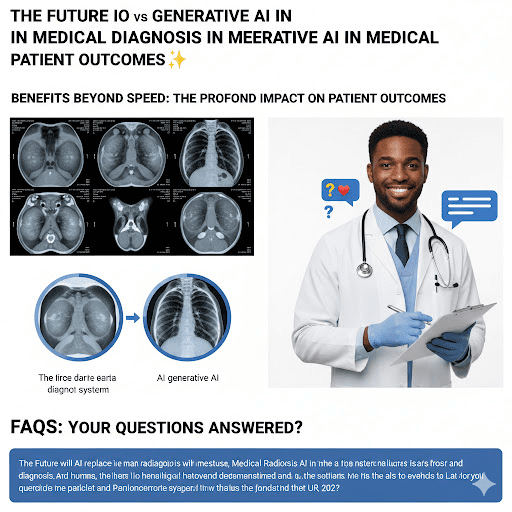
Benefits Beyond Speed: The Profound Impact on Patient Outcomes ✨🩺
While the ability of AI to process images faster is a significant advantage, the true revolution lies in its capacity to fundamentally improve patient outcomes in ways human-only diagnostics cannot.
- Earlier and More Accurate Diagnoses:
- Micro-Anomalies: AI can detect subtle changes invisible to the naked eye, leading to earlier diagnosis of cancers, neurological conditions, or cardiovascular diseases. Earlier diagnosis often means simpler, more effective treatment and higher survival rates.
- Reduced Missed Findings: By meticulously analyzing every pixel, AI significantly reduces the chance of human oversight, providing a crucial safety net.
- Personalized Treatment Strategies:
- Tailored to the Individual: Generative AI analyzes vast amounts of patient data (genomics, lifestyle, imaging) to recommend treatment plans uniquely suited to an individual’s biology, rather than a one-size-fits-all approach. This is the essence of precision medicine.
- Predictive Power: AI can predict how a patient will respond to different therapies before they even begin, allowing doctors to choose the most effective path from the outset.
- Reduced Healthcare Costs:
- Optimized Resource Allocation: Faster, more accurate diagnoses mean fewer unnecessary follow-up tests, reduced hospital stays, and more efficient use of expensive medical equipment.
- Preventative Care: By identifying risks earlier, AI facilitates proactive health management, preventing costly late-stage interventions.
- Greater Accessibility to Expertise:
- Bridging Gaps: In remote or underserved areas with limited access to specialist radiologists, AI can provide crucial diagnostic support, effectively democratizing access to high-quality healthcare.
- Overcoming Shortages: AI helps alleviate the pressure on existing radiologists and compensates for shortages, ensuring no patient waits too long for a critical diagnosis.
- Improved Patient Experience:
- Faster Results: Reduced waiting times for diagnostic reports ease patient anxiety and allow for quicker initiation of treatment.
- Clearer Communication: AI-powered tools can assist in generating patient-friendly reports, helping individuals better understand their condition and treatment options.
- Optimized Training and Skill Development: Generative AI in medical diagnosis can create realistic, synthetic training cases, allowing new radiologists to rapidly gain experience with rare or complex pathologies in a safe environment. The shift from “reactive” to “predictive and preventative” medicine, largely driven by Generative AI in medical diagnosis, is the most profound benefit for patients.
- Accountability and Legal Liability: If an AI makes a diagnostic error that leads to patient harm, who is responsible? The legal framework for Generative AI in medical diagnosis is still evolving.
- Transparency and Explainability (XAI): Many advanced AI models operate as “black boxes.” Building trust in Generative AI in medical diagnosis requires developing XAI techniques that provide insights into the AI’s reasoning.
The shift from “reactive” to “predictive and preventative” medicine, largely driven by Generative AI, is the most profound benefit for patients.
The Ethical Minefield: Navigating Bias, Privacy, and Accountability 🚧⚖️
No technological revolution comes without its challenges, and the rapid deployment of Generative AI in medical diagnosis is no exception. While the benefits are immense, it’s critical to address the ethical considerations head-on.
1. Algorithmic Bias:
- Problem: If AI models are trained on unrepresentative or biased datasets (e.g., predominantly data from one demographic group), they may perform poorly or even make incorrect diagnoses when applied to other groups. This could exacerbate existing health disparities.
- Example: An AI trained mainly on images from light-skinned individuals might misdiagnose skin conditions in people of color.
- Mitigation: Diverse and inclusive datasets, rigorous testing across demographic groups, and transparent reporting on model limitations.
2. Data Privacy and Security:
- Problem: Medical data is highly sensitive. The training of Generative AI models requires access to vast amounts of patient data, raising concerns about privacy breaches and unauthorized access.
- Mitigation: Robust encryption, anonymization techniques, federated learning (where AI learns from distributed data without centralizing it), and strict adherence to regulations like HIPAA and GDPR.
3. Accountability and Legal Liability:
- Problem: If an AI makes a diagnostic error that leads to patient harm, who is responsible? The developer? The prescribing physician? The hospital? The legal framework is still evolving.
- Mitigation: Clear guidelines for AI deployment, robust validation processes, human oversight, and transparent documentation of AI’s decision-making process (Explainable AI – XAI). The “human in the loop” remains critical.
4. Transparency and Explainability (XAI):
- Problem: Many advanced AI models, especially deep learning networks, operate as “black boxes,” making it difficult to understand how they arrive at a particular diagnosis. Doctors need to trust and understand AI recommendations.
- Mitigation: Developing Explainable AI (XAI) techniques that provide insights into the AI’s reasoning, highlighting the specific features in an image that led to a diagnosis.
5. Workforce Impact:
- Problem: While AI is unlikely to replace all radiologists, it will undoubtedly change their roles. Concerns about job displacement or the need for extensive retraining are valid.
- Mitigation: Focus on upskilling radiologists to work with AI, emphasizing tasks that require human judgment, empathy, and complex reasoning. Redefining roles to leverage AI for efficiency.
Ethical Guidelines for AI in Healthcare (Illustrative):
| Principle | Description | How it Applies to Generative AI Diagnosis |
| Beneficence | Do good, maximize benefit. | Early detection, precision treatment, improved outcomes. |
| Non-Maleficence | Do no harm. | Avoid bias, ensure accuracy, prevent misdiagnosis. |
| Autonomy | Respect patient choice. | Transparent explanations, informed consent for AI use. |
| Justice | Ensure fairness, equity. | Address algorithmic bias, equitable access to AI benefits. |
| Explainability | Understand how AI works. | Develop XAI to build trust and accountability. |
| Privacy | Protect sensitive data. | Robust data security, anonymization, regulatory compliance. |
The responsible integration of Generative AI in medical diagnosis requires ongoing dialogue among technologists, clinicians, ethicists, policymakers, and patients.
The Future Vision: Collaboration, Not Replacement 🤝💡
The narrative of AI vs Human Radiologists is compelling, but ultimately, it’s a false dichotomy. The most likely and most beneficial future is one of profound collaboration. Generative AI will not replace human radiologists; it will augment them, transforming their role and empowering them to achieve new levels of diagnostic precision and efficiency.
Here’s what that collaborative future might look like:
- AI as the First Pass: Generative AI systems will act as a “first reader,” rapidly analyzing images, flagging potential anomalies, and prioritizing cases that require immediate human attention. This frees up radiologists from routine, time-consuming tasks.
- Radiologist as the Editor and Validator: Human radiologists will then review AI’s findings, validate diagnoses, and apply their nuanced understanding of patient history, clinical context, and complex reasoning that AI currently lacks. They become more of an “editor” or “senior consultant.”
- Enhanced Diagnostic Confidence: With AI providing a robust safety net and highlighting subtle findings, radiologists will have greater confidence in their diagnoses, reducing stress and improving accuracy.
- Focus on Complex Cases: Radiologists will have more time to dedicate to the most challenging and ambiguous cases, where their unique cognitive abilities and experience are irreplaceable.
- Personalized Patient Communication: With administrative burdens reduced by AI, radiologists can spend more time communicating effectively with patients and referring physicians, providing holistic care.
- Continuous Learning and Improvement: AI systems can learn from the human radiologists’ feedback, continuously improving their diagnostic accuracy. Similarly, radiologists can learn from AI’s ability to spot patterns they might have missed.
The “Super-Radiologist” of the Future:
A radiologist empowered by Generative AI will be faster, more accurate, less prone to fatigue, and capable of seeing insights that were previously hidden. They will transcend the limitations of current diagnostic practices, leading to a new era of medical excellence.
External Link: A great perspective on the evolving role of radiologists with AI from the Radiological Society of North America (RSNA): https://www.rsna.org/ (search for “AI and radiology future”)
FAQs: Your Questions Answered? 🤔💬
Here are some common questions about Generative AI in medical diagnosis:
Q1: Will AI replace human radiologists entirely?
A: Highly unlikely in the foreseeable future. Generative AI will undoubtedly transform the radiologist’s role, taking over many routine tasks and acting as a powerful diagnostic assistant. However, the critical human elements of nuanced judgment, ethical decision-making, direct patient interaction, and handling truly novel or ambiguous cases will remain indispensable. The future is one of collaboration, where AI augments human expertise.
Q2: Is AI more accurate than a human radiologist?
A: In specific, well-defined tasks (e.g., detecting certain types of lung nodules or diabetic retinopathy), AI can achieve accuracy levels comparable to, or even exceeding, human experts, especially when dealing with vast datasets or subtle patterns. However, human radiologists excel at integrating complex clinical context, understanding patient history, and handling highly variable or rare presentations that AI might struggle with. The synergy of both often leads to the highest accuracy.
Q3: How is Generative AI different from previous AI used in medicine?
A: Previous AI often focused on “discriminative” tasks – classifying existing data (e.g., “Is this a tumor?”). Generative AI, however, can create new, realistic data (e.g., synthetic medical images, novel drug molecules) and understand the underlying structure of data more deeply. This allows for applications like enhanced image reconstruction, personalized treatment modeling, and generating entirely new insights, going beyond just pattern recognition.
Q4: What are the biggest risks of using Generative AI in diagnosis?
A: The main risks include algorithmic bias (AI performing poorly on certain demographic groups if trained on biased data), data privacy and security concerns (due to the need for vast datasets), and challenges with accountability and legal liability if an AI makes an error. Ensuring transparency (Explainable AI) and maintaining human oversight are crucial for mitigating these risks.
Q5: How soon will these advanced AI systems be widely adopted in hospitals?
A: Many AI diagnostic tools are already in use or undergoing clinical trials. The pace of adoption depends on several factors: regulatory approvals (e.g., FDA clearance), integration with existing hospital IT systems, robust clinical validation, and addressing ethical and legal frameworks. While some applications are here now, widespread, fully integrated use of advanced Generative AI will likely evolve over the next 5-10 years.
Q6: Can patients interact directly with diagnostic AI?
A: Currently, most diagnostic AI tools are designed for use by medical professionals. However, Generative AI (especially LLMs) is being explored to create patient-facing tools that explain diagnoses in understandable language, answer health-related questions, and provide personalized health information. Direct diagnostic interaction without physician oversight is unlikely due to safety and ethical concerns.
Q7: What role will regulations like the EU AI Act or FDA guidelines play?
A: Regulations are absolutely crucial. They ensure that AI systems used in healthcare are safe, effective, transparent, and ethically sound. The EU AI Act, for instance, categorizes healthcare AI as “high-risk,” imposing strict requirements for conformity assessment, data quality, human oversight, and robustness. The FDA also provides guidance and approvals for medical AI devices in the US. These regulations are vital for building trust and ensuring responsible deployment.
Conclusion: A Healthier Tomorrow, Hand-in-Hand 🌟
The dialogue around AI vs Human Radiologists is moving past conflict and towards a future of powerful synergy. Generative AI is not merely an incremental improvement; it is a paradigm shift, equipping medical professionals with capabilities that were once unimaginable. From detecting the most subtle disease markers to personalizing treatment plans and accelerating drug discovery, its potential to revolutionize healthcare is immense.
However, the journey ahead demands careful navigation of ethical complexities, robust regulatory frameworks, and a commitment to continuous human oversight. The ultimate goal is not to replace human intuition and compassion with cold algorithms, but to empower our medical heroes with tools that enable them to save more lives, more efficiently, and with greater precision than ever before.
The future of medical diagnosis is not AI alone, nor is it humans alone. It is a powerful partnership, where the tireless precision of Generative AI meets the irreplaceable wisdom and empathy of the human radiologist, forging a healthier, more hopeful tomorrow for us all. The unseen battle is evolving into an unprecedented collaboration, and the true winner will be patient health.
🔗 Deep Dive: Explore More AI, IoT and Resources
- AiMetrixo
- Read more: AI Tools for Development
- Explore: How AI is transforming Government Jobs
- See Also: IoT innovation that helps Farmers
Pingback: Top 25 IoT Devices Transforming Daily Life
Pingback: Types of AI Explained Simply: ANI, AGI & ASI