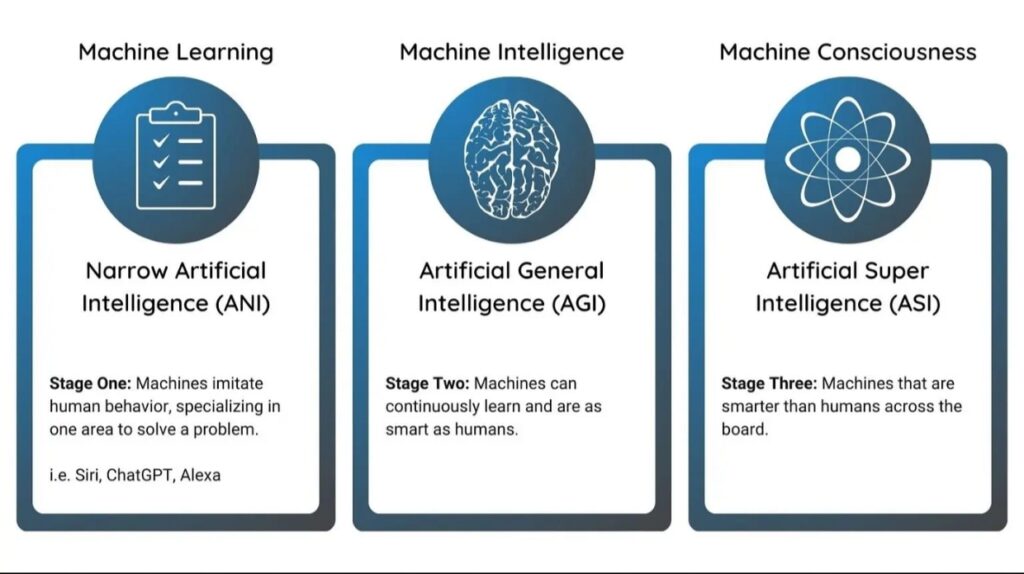
Understanding the Types of AI is essential if you want to grasp how Artificial Intelligence evolves from simple tasks to potentially super intelligent systems.
In this tutorial, we break down ANI, AGI, and ASI in the simplest way possible — with visuals, tables, examples, and analogies that anyone can understand.
By the end, you will clearly know:
- What each type of AI means
- How advanced each type is
- Where we currently are
- What the future may look like
- Why these distinctions matter
Let’s begin!

Table of Contents
🤖 What Are the Types of AI? (Simple Definition)
There are three types of AI based on capability:
1️⃣ ANI – Artificial Narrow Intelligence
2️⃣ AGI – Artificial General Intelligence
3️⃣ ASI – Artificial Superintelligence
These describe how capable an AI system is and how much intelligence it possesses compared to humans.
⭐ 1️⃣ ANI – Artificial Narrow Intelligence
(Also called Weak AI or Narrow AI)
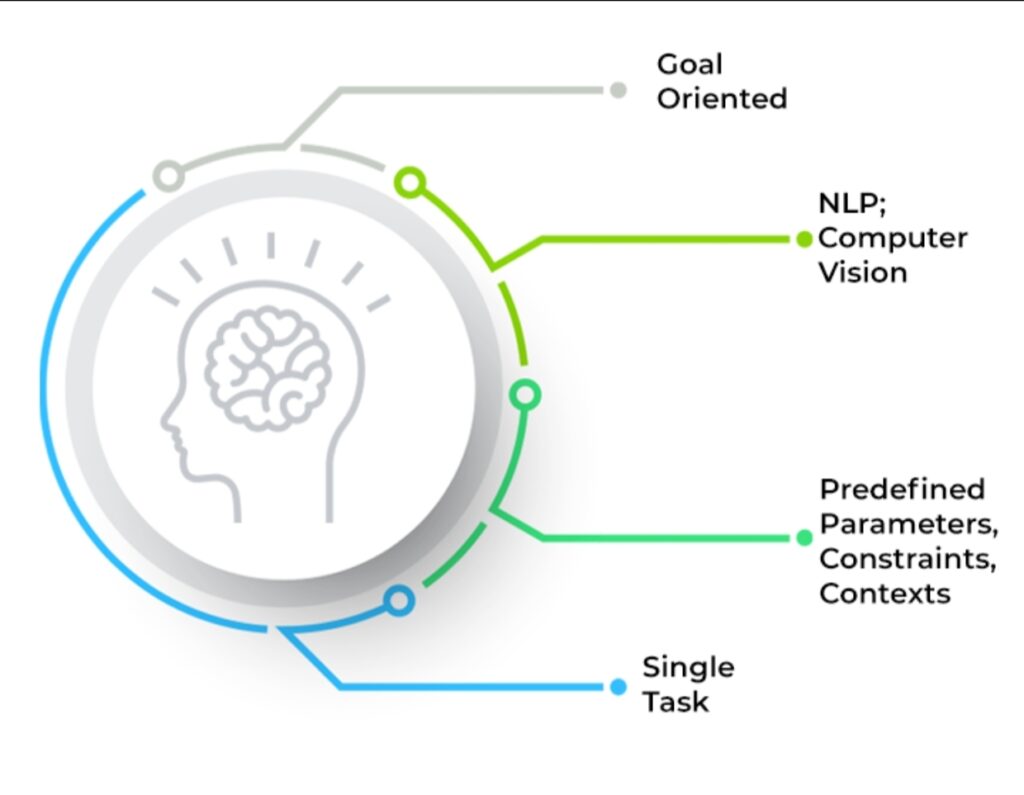
ANI is the AI we use today.
It can perform one specific task very well but cannot think or understand beyond that.
🔍 Examples of ANI
- Face unlock on phones
- Google Maps route prediction
- YouTube recommendations
- Instagram filters
- Chatbots
- Medical scan analysis
- Language translation tools
ANI does not understand the world — it only works within the boundaries of its programming and data.
🟦 Why ANI Matters ?
ANI powers all modern applications. It is reliable, fast, and extremely good at narrow tasks.
🔧 ANI Explained Simply
Think of ANI as:
“A specialist — excellent at one thing, but limited to that one thing.”
Like a calculator: amazing at math, but cannot write a story.
🧠 2️⃣ AGI – Artificial General Intelligence
(Also called Strong AI or Human-Level AI)
AGI refers to a machine that can:
- Understand
- Learn
- Think
- Reason
- Make decisions
- Adapt like a human
AGI would be able to perform any intellectual task a human can — not just one specific task.
📍 Current Status
AGI does not exist yet.We are still at ANI, though modern AI is rapidly evolving.
🌐 What AGI Could Do (Hypothetical)
- Understand emotions
- Learn multiple skills
- Solve complex problems
- Think abstractly
- Make ethical decisions
- Adapt across fields
🟩 AGI Explained Simply
AGI would be like:
“A digital human brain that can understand and learn anything.”
This is the goal many AI researchers dream of — true thinking machines.
💫 3️⃣ ASI – Artificial Superintelligence
(Beyond Human Intelligence)

ASI is a theoretical form of AI that surpasses all human intelligence in:
- Creativity
- Problem solving
- Scientific research
- Emotional understanding
- Strategy
- Decision-making
ASI would outperform the smartest humans in every field.
⚠️ Why ASI Is Powerful
- Imagine a system that can:
- Discover new medicines in minutes
- Solve climate problems
- Fix global economic issues
- Invent new technologies
- Create advanced scientific theories
ASI would bring unimaginable progress.
🟥 The Ethical Question
With such power, there are risks.This is why AI safety research is extremely important.
📊 Comparison Table: ANI vs AGI vs ASI
| Feature | ANI | AGI | ASI |
|---|---|---|---|
| Intelligence Level | Narrow | Human-Level | Beyond Human |
| Task Capability | Single task | Any task | Unlimited |
| Exists Today? | ✔ Yes | ❌ No | ❌ No |
| Learning Ability | Limited | Flexible | Superhuman |
| Real-World Impact | High | Potentially massive | Unknkown |
🎯 Where Are We Today in the Types of AI?
We are currently in:
👉 ANI era
Modern AI tools look smart but don’t understand meaning the way humans do.
However, with increasing advancements:
- Large Language Models
- Multi-modal AI
- Autonomous agents
…we are moving closer toward early forms of AGI.
🌐 ANI in Daily Life (Real Examples)
Understanding Types of AI becomes easier with real-world cases.
📱 Smartphones
- Voice assistants
- Face ID
- Photo enhancement
🏥 Healthcare
- MRI scanning
- Drug predictions
- Early cancer detection
🏦 Finance
- Fraud prevention
- Credit scoring
🚗 Vehicles
- Lane detection
- Autopilot assistance
These are powerful, but still narrow AI.
🧠 AGI Possibilities in the Future
AGI could:
- Teach itself new skills
- Understand human emotions
- Work like a human across multiple domains
- Assist in scientific breakthroughs
Imagine a machine that can:
- 📘 Learn physics
- 🎨 Paint artwork
- 🧮 Solve mathematics
- 💬 Discuss philosophy
- 🧠 Understand complex emotions
All in one system — that is AGI.
💡 ASI — A Step Beyond Imagination
ASI could:
- Design better AIs
- Innovate at extreme speed
- Create solutions humans can’t imagine
- Analyze oceans of data instantly
This type of AI is the subject of many movies, debates, and ethical discussions.
⏳ Evolution of AI (Timeline Concept)

Although we cannot predict exact timelines, this is the general progression AI researchers expect.
📘 Why Understanding Types of AI Matters
Here’s how this knowledge helps you:
- You understand what AI can and cannot do
- You stay updated with technological progress
- You can make AI-driven career or business decisions
- You avoid myths and misinformation
- You prepare for future opportunities
🔗 Discover More
- AI Tutorial #1: What Is Artificial Intelligence?
- AI in Health
- AI Tools
- 101 ways AI is changing life
- AI in Government Jobs
- IoT innovation
- IoT water solution
🌍 External Reference Links
🏁 Conclusion: Types of AI Explained
You now understand the Types of AI:
- ANI (today’s AI)
- AGI (human-level AI)
- ASI (superintelligent AI)
This foundation prepares you for deeper AI concepts in upcoming tutorials.
Next, we explore Machine Learning Basics in Tutorial #3.
Pingback: What Is Artificial Intelligence? A Complete Beginner-Friendly Guide #1
Pingback: Master the Future #3: Ultimate Machine Learning Basics for Beginners