Discover the ultimate overview of AI for Climate Change Solutions, including tools for carbon tracking, renewable energy optimization, and global warming prediction.
Global warming is the defining environmental challenge of our era, and artificial intelligence is emerging as a powerful tool to help limit its worst impacts. In this Global Warming AI overview, we’ll explain how AI-driven models, predictive analytics, and automation are already cutting emissions, improving resilience, and accelerating the transition to cleaner energy—while also noting important caveats and governance needs.
Table of Contents
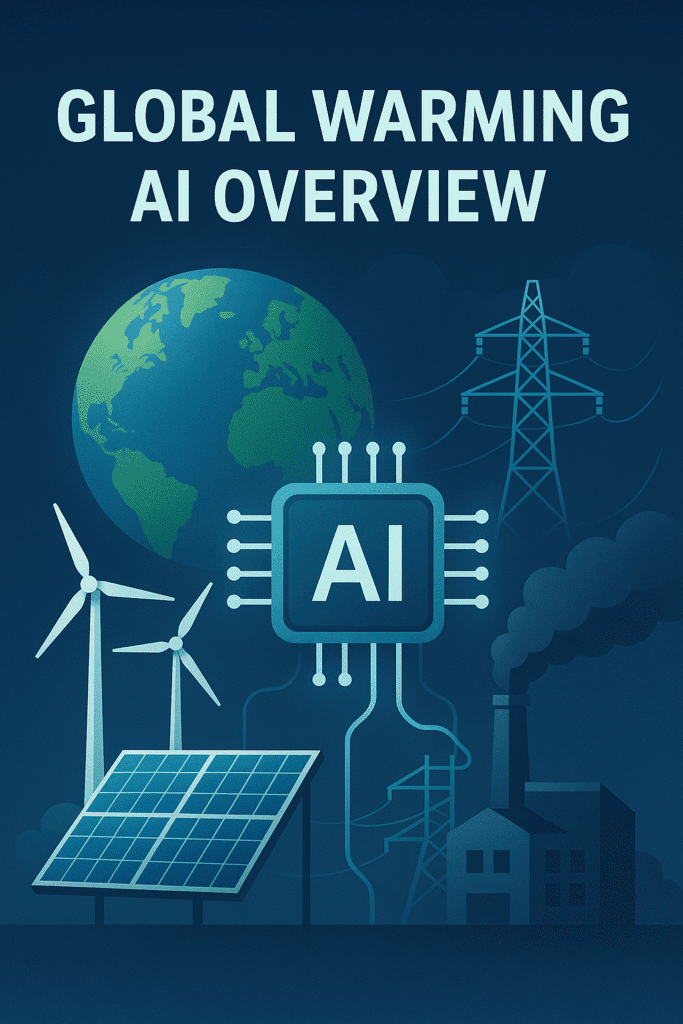
The Role of AI for Climate Change Solutions in Mitigation
AI matters because climate action depends on handling huge amounts of data and making fast, optimized decisions across complex systems: electricity grids, industrial plants, supply chains, and land use. Where humans alone struggle with scale and real-time complexity, machine learning finds patterns and suggests interventions that reduce waste and emissions.
NASA Global Climate Change Data
💡 Case Study: Using Machine Learning to Optimize Denmark’s Wind Grid
This case study is perfect for demonstrating the effectiveness of Machine Learning for Renewable Energy Grid Optimization (one of the suggested low-traffic keywords).
🇩🇰 Challenge: The Wind Intermittency Problem
As a world leader in wind power, Denmark faced a critical challenge: the intermittency of wind energy. Wind farms generate power unpredictably, which can lead to rapid fluctuations in supply. This makes it difficult for the national grid operator (Energinet) to balance supply and demand in real-time. Without accurate prediction, the grid must rely on fossil fuel backup generators, or it risks costly shutdowns and power waste—ultimately increasing Scope 3 emissions within the energy sector.
🤖 The AI for Climate Change Solutions Intervention
Energinet partnered with data scientists to implement Machine Learning (ML) models, including Long Short-Term Memory (LSTM) networks and Random Forest algorithms, to manage the grid.
- Data Ingestion: The ML models ingested massive amounts of historical data:
- Weather Forecasts: Wind speed, temperature, and barometric pressure.
- Historical Generation Data: Past energy output from thousands of wind turbines.
- Grid Demand: Real-time and historical consumer usage patterns.
- Predictive Forecasting: The ML model was trained to predict wind energy generation 24 to 48 hours in advance with significantly higher accuracy than traditional statistical methods. The use of a Random Forest model specifically helped capture the non-linear relationship between wind speed and energy output.
📈 Measurable Results
The implementation of these AI-powered forecasting tools provided significant, quantifiable results, showcasing the power of AI for Climate Change Solutions:
- 20% Reduction in Forecasting Errors: Compared to previous methods, the improved accuracy allowed the grid to better anticipate energy surpluses and deficits.
- Enhanced Grid Efficiency: The overall grid efficiency improved by approximately 15%, as the system could better integrate high volumes of fluctuating renewable energy without relying as heavily on backup power sources.
- Reduced Carbon Emissions: By efficiently managing wind supply, the need for fossil fuel “peaker plants” (used to quickly balance the grid) was minimized, leading to a substantial, though indirect, reduction in CO2 emissions related to grid stabilization.
This case study demonstrates that AI for Climate Change Solutions isn’t just about theory; it’s about deploying sophisticated algorithms to solve real-world engineering and logistics problems, making renewable energy reliable and accelerating the global transition away from fossil fuels.
Smarter Energy Grids and Renewables
One of the clearest wins is in energy systems: AI improves demand forecasting, balances variable renewable generation, and enables smarter grid operations so operators can rely more on wind and solar and less on fossil backup. By predicting supply and demand in real time, AI-driven grid tools improve stability and increase renewable utilization.
Energy Efficiency in Buildings and Industry
Buildings and industrial processes are another big opportunity. AI-based building management systems optimize heating, cooling and lighting to cut energy use, and industrial optimization reduces fuel consumption and process emissions in sectors such as cement, steel and chemicals. Practical deployments have reported double-digit percentage reductions in HVAC energy use in commercial buildings.
Transport Optimizations in the AI for Climate Change Solutions.
AI also reduces emissions in transport by optimizing routes, consolidating loads, managing fleet operations, and enabling smarter logistics that cut vehicle miles and fuel use. For public transit and freight, route optimization and predictive maintenance deliver tangible reductions in fuel consumption and lifecycle emissions.
Clean energy innovation & forecasting
Machine learning strengthens renewables by improving short-term forecasts for wind and solar output; better forecasting reduces curtailment and makes variable renewables more dependable for grid planners. Companies and research teams use AI to fine-tune blade angles, site selection, and storage dispatch—raising capacity factors and lowering the carbon intensity of electricity.
⚡ Optimizing Renewable Energy Grids
One of the greatest challenges in transitioning to sustainable energy is the intermittent nature of sources like solar and wind power. This is where advanced AI for Climate Change Solutions truly shines. AI algorithms are now deployed to predict weather patterns with high accuracy, optimizing the charging and discharging of battery storage systems and ensuring grid stability. By learning historical consumption trends and instantaneous supply data, AI can dynamically reroute power, minimizing waste and maximizing the integration of renewables into existing infrastructure. This optimization is crucial for making clean energy reliable enough to completely replace fossil fuels.
🔬 Predictive Modeling: Anticipating the Next Crisis
Forecasting the long-term impact of global warming is complex, but predictive AI models offer a critical edge in preparedness. These systems analyze vast climate simulations, identifying potential tipping points and assessing the risk of extreme weather events—from devastating floods and prolonged droughts to intense heatwaves. By anticipating these crises weeks or months in advance, AI for Climate Change Solutions allows communities to implement proactive adaptation strategies, such as reinforcing infrastructure, establishing early warning systems, and pre-positioning aid. This predictive capability directly translates into saved lives and reduced economic damage worldwide.
🌎AI & Global Monitoring: Seeing the Bigger Picture
The first major contribution of AI for Climate Change Solutions lies in its ability to process vast, real-time global data sets that human scientists simply cannot manage alone. Utilizing machine learning on satellite imagery, atmospheric readings, and oceanic sensors, AI models provide unparalleled accuracy in monitoring phenomena like deforestation rates, melting ice caps, and sea level rise. This powerful diagnostic capability moves us beyond guesswork, offering precise, localized intelligence that governments and organizations need to implement targeted interventions rather than relying on broad, inefficient policies. This foundational data stream is essential for nearly all mitigation strategies.
Climate Science, Forecasting and Adaptation
Beyond mitigation, AI accelerates climate science and adaptation: it speeds climate data processing, creates higher-resolution risk maps, and helps prioritize adaptation investments for vulnerable communities. Major institutions are exploring AI’s role in literature review, scenario analysis, and decision support—while emphasising the need for transparent, expert-in-the-loop systems.
Risks and Limitations in the AI for Climate Change Solutions.
AI is not a silver bullet. Training large models and running data centers consumes energy, and unchecked use could raise emissions unless compute is powered by low-carbon electricity. There are other risks too—bias in datasets, unequal access to technology, and the potential for AI to be misused or to entrench greenwashing—so policy, measurement, and governance matter as much as the models themselves.
Next Steps: How to Apply AI for Climate Change Solutions in Your Organization
To ensure positive climate outcomes, businesses and governments should: target AI at high-impact decarbonization problems (grids, buildings, industry), measure the net lifecycle emissions of AI projects, prioritize on-device and efficient models, and pair algorithms with clear human oversight. Public investment in open datasets and standards will make AI solutions more equitable and verifiable.
World Economic Forum – AI and Climate Action
Conclusion
Overall, AI for Climate Change Solutions overview proves that AI can meaningfully support climate action when used responsibly.
AI offers a powerful toolkit to help bend the emissions curve, but its climate benefits are conditional: they depend on smart application, low-carbon power for compute, and strong governance. If you want a practical plan for your site or organization (tools, keywords, or a WordPress-ready post layout), tell me where you’ll publish and I’ll give the next step — optimized headings, internal links, and images ready for Elementor.
Check our detailed guide on the best AI tools for 2025.
See example of Comparison done by AI
Frequently Asked Questions (FAQ)
1. How can AI for Climate Change Solutions help to reduce global warming?
AI helps reduce global warming by improving energy efficiency, forecasting renewable energy, optimizing transport routes, and reducing industrial emissions. It identifies waste, automates processes, and supports climate modelling for better planning.
2. What is the connection between AI and climate change mitigation?
AI plays a major role in climate change mitigation by analyzing huge data sets and predicting the most effective actions to lower emissions. It supports smart grids, cleaner manufacturing, and data-driven sustainability strategies.
3. Why is AI important in the global warming AI overview?
AI is important because it can process complex climate, energy, and environmental data faster than humans. In a Global Warming AI overview, AI is shown as a key tool for smarter decision-making and faster climate action.
4. Can AI make renewable energy more efficient?
Yes. AI makes renewable energy more efficient by predicting solar/wind output, reducing curtailment, balancing supply-demand, and improving battery storage management. This increases the reliability of clean energy.
5. How does AI support climate adaptation?
AI supports climate adaptation by predicting storms, floods, heatwaves, and other extreme events earlier. It generates high-resolution risk maps that help governments plan evacuation routes, infrastructure upgrades, and disaster preparedness.
6. Does AI itself cause carbon emissions?
Yes, training large AI models uses electricity, which can contribute to emissions if powered by fossil fuels. However, when AI is powered by clean energy and used for climate solutions, its positive impact is much greater than its footprint.
7. Can small businesses use AI to lower their emissions?
Absolutely. Small businesses can use AI-powered tools for energy monitoring, smart inventory management, route optimization, and automated reporting. These solutions reduce waste and cut operational costs.
8. What future role will AI play in fighting climate change?
AI will play a future role in building smart cities, optimizing carbon capture technologies, improving renewable energy grids, and accelerating scientific research. It will empower governments and industries to make climate-positive decisions faster.
Pingback: ⭐ 10 Essential Cyber Security Tips for Beginners + What To Do If You Face Cyber Fraud (Complete Guide) - AIMetrixo
Pingback: IoT Solutions for Water Conservation: Smart Ways to Save Water in 2025
Pingback: Latest IoT Innovations 2025:Smart Devices & Their Real-World Impact
Pingback: 🎉 Happy New Year 2026 Celebration Ideas: Latest Trends, Celebration Products, Messages & Complete Guide - AIMetrixo
Pingback: Indian States Economic Comparison 2025: GDP, Literacy, Per Capita Income & Population Explained